Our AI agents work inside your existing systems. They forecast demand, recalculate reorder points and draft purchase orders, then send your planners a short list of decisions with the reasoning attached. Nothing is ordered until a person approves it.
From $10,000 · 6–10 weeks
- extraction accuracy on Intelligent BoM
- 0%
- per engineering drawing
- 0 s
- deployments, never trained on your data
- Private
If this sounds like your week, we should talk.
- “Stock-outs on fast movers while slow movers fill the warehouse.”
- “Reorder points set once and never revisited.”
- “Planners spending the week on data entry instead of decisions.”
What you get.
Shaped around your process and the data you already have.
Demand forecasting
Forecasts per SKU from your sales history and seasonality, updated every week with a confidence range.
Reorder recommendations
Reorder points, safety stock and suggested order quantities recalculated for every SKU and kept current.
An approval queue, not a black box
Each recommendation arrives with the numbers behind it. Approve, edit or reject, and the result is written back to your ERP.
Document AI
Drawings, invoices and quotes turned into structured data. Our Intelligent BoM reads engineering drawings in about 5 seconds.
Where it fits.
Planners with too many SKUs
Reorder points and safety stock recalculated for every SKU each week, with only the exceptions sent to a person.
Businesses with seasonal or volatile demand
Forecasts that move with the season and with recent sales, so buying reacts in days.
Estimating and engineering teams
Drawings, P&IDs and quotes read into a costed bill of materials instead of being typed out line by line.
Want the detail first? Read: How to calculate reorder point and safety stock, with a worked example
Proof: Intelligent BoM.
Turns engineering drawings and P&IDs into a costed bill of materials in Excel, powered by Gemini vision.
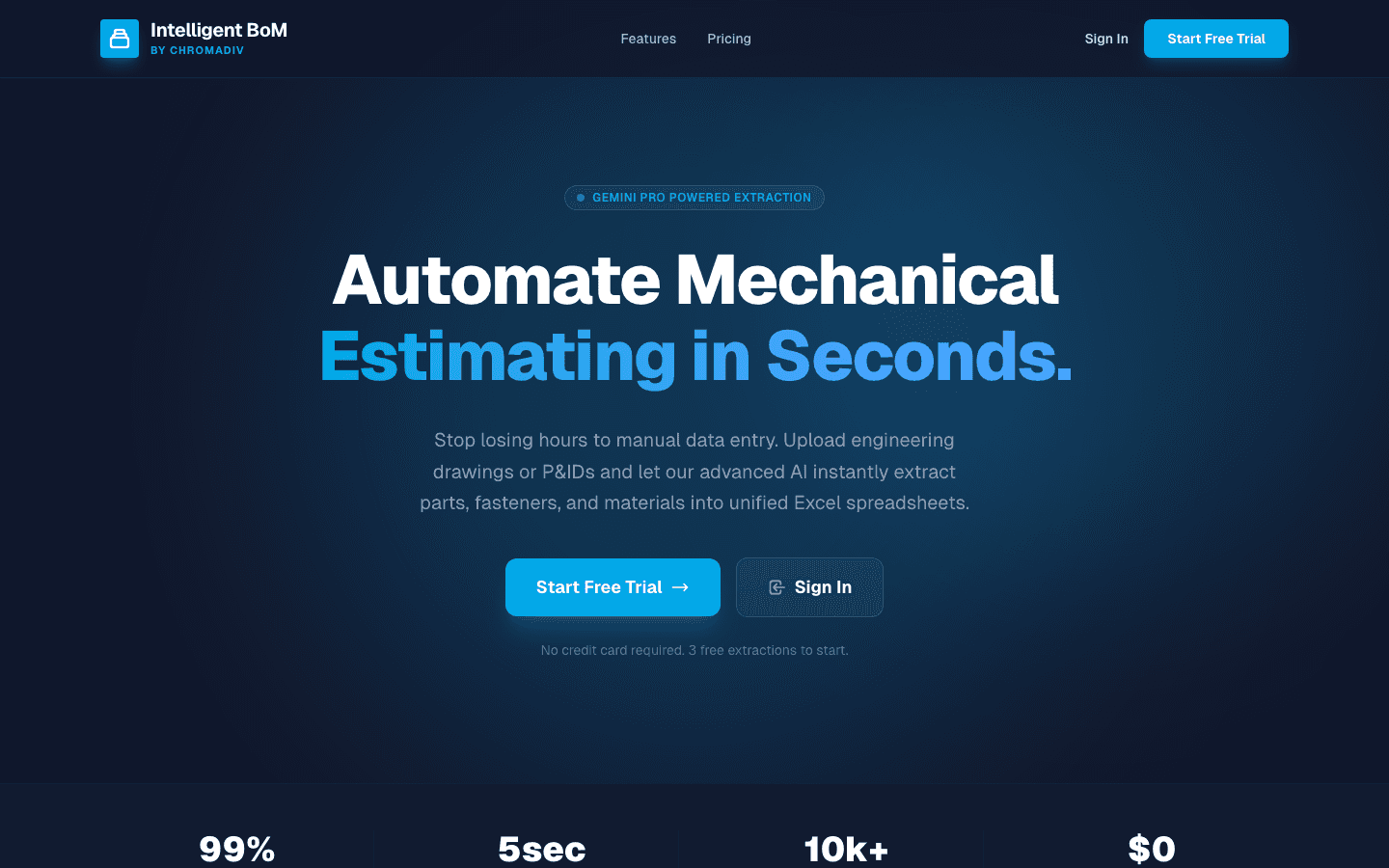
- extraction accuracy
- 99%
- per drawing
- 5 s
From first call to live system in 6–10 weeks.
A simple, low-risk process. You see working software every week, and you always know what’s next.
Step 1 · Day 1
Free audit.
A 30-minute call to map where time and money leak, and find the first thing worth automating. You leave with next steps, whether or not you hire us.
Step 2 · Weeks 1–2
Health Check or blueprint.
Start with the fixed-price Inventory Health Check, or go straight to a blueprint: we map the process, connect to your data sources and agree the numbers that define success. Either way you get a written scope, timeline and fixed price before anything is built.
Step 3 · Weeks 2–8
Build.
Weekly demos on your real data, integrated with your ERP, accounting system or spreadsheets. Your team shapes it as we go, so there are no surprises at launch.
Step 4 · Weeks 8–10
Launch and improve.
Go-live, training for your team and monitoring of the numbers we agreed. Then we find the next win.
Step 1 costs nothing and takes 30 minutes.Book your free audit
AI Agents for Inventory Planning: common questions.
Do the agents act on their own?
Not unless you want them to. Every project starts with agents that recommend and people who approve. Some teams later let low-risk actions run automatically once they trust the results.
Is our operational data safe?
Yes. We deploy private, isolated instances. Your procurement, inventory and logistics data is never used to train public models.
How much does an AI agent cost?
Agent projects start at $10,000, depending on the number of SKUs, systems and decisions involved. You get a fixed quote after the free audit.
Do they work with our ERP?
Yes. Agents read from and write back to your ERP or inventory system through its API, so recommendations land where your team already works.
What are AI agents in supply chain?
AI agents are software that watches your data, makes a specific decision or recommendation, then acts or alerts a person. In supply chain they are used for demand forecasting, reorder points and safety stock, supplier screening, and reading documents such as invoices and engineering drawings.
How much historical data do we need?
For demand forecasting, 12 to 24 months of sales or usage history per SKU gives the best results. With less, we start with simpler rules and improve the model as your data builds up.
Let’s find your first win.
A free supply chain automation audit with a senior operator. Here’s what you get:
- 30 minutes on video, at a time that suits you
- Where your supply chain leaks time and money
- The first thing worth automating, and what it’s worth
- No obligation and no sales pitch
Prefer email?
Explore other services
Inventory Health Check
A two-week, fixed-price review of your stock: what to clear, what to reorder and how much cash it frees.
Supply Chain Dashboards
One live view of stock, orders and suppliers, pulled from the systems you already use.
Landed Cost & Procurement Automation
True landed cost per SKU, suppliers compared side by side and late purchase orders chased for you.